Remember when your uncle called his broker to buy shares? The broker took a cut of every trade, often 0.3% or more, and you paid whether you won or lost. A Jaipur trader I know once paid more in brokerage than he made in a month.
Then Zerodha showed up in 2010 with a flat fee and no sales team. The Zerodha business model looks almost too simple, which is exactly why it worked. Here’s how it works, why it won, and what’s changed by 2026.
What Is the Zerodha Business Model?
The Zerodha business model is a discount-broking model: charge a low flat fee, skip advertising and sales staff, and make money from huge trading volumes. Zerodha charges zero brokerage on equity delivery and a flat ₹20 (or 0.03%, whichever is lower) on intraday and F&O orders.
Nithin and Nikhil Kamath started it, and they never took outside investor money. That choice shaped everything. No investors meant no pressure to chase growth at any cost.
How Zerodha Makes Money
Free delivery trades sound like charity. They’re not.
Zerodha earns mainly from flat brokerage on intraday and F&O trades. Smaller streams include demat annual maintenance charges, interest on client funds and a lending arm, Zerodha Capital. Free equity delivery brings in customers, and active traders pay the bills.
Here’s the catch. Annual maintenance fees contribute only around 2% of revenue, and the rest depends on customers continuing to trade. I think that’s the most honest way to describe it: Zerodha is a bet on traders staying active. tribuneindia
Why Traditional Brokers Couldn’t Respond
Old brokers had branches, relationship managers and commission-hungry agents. Matching a ₹20 flat fee would have killed their margins.
So they couldn’t copy it. Zerodha had no branches to feed and no sales team to pay. Its costs were mostly technology and a small support team, so every extra customer added almost pure profit.
No Ads, No Sales Team: Growth Through Word of Mouth
Zerodha spent almost nothing on advertising. Customers came because friends told them.
Nithin Kamath wrote openly, spoke on podcasts and explained things plainly. Trust did the work that ad budgets do for others. Think about it: when did you last trust a broker’s advertisement over a friend’s recommendation?
This is the part many founders skip. Brand-building through honesty is slow, but it costs a fraction of paid marketing and it sticks.
Technology and Product Moves That Locked Customers In
Zerodha built its own tools instead of renting them. The main ones:
- Kite, the trading platform, fast and clean enough that rivals copied it
- Coin, for direct mutual funds with no commission
- Varsity, free investor education that doubles as marketing
- Console, for portfolio reports and tax statements
Varsity deserves a mention. Free learning content brought in beginners who later became traders. It’s content marketing before the term got overused.
Zerodha Business Model Numbers: Profit and Scale
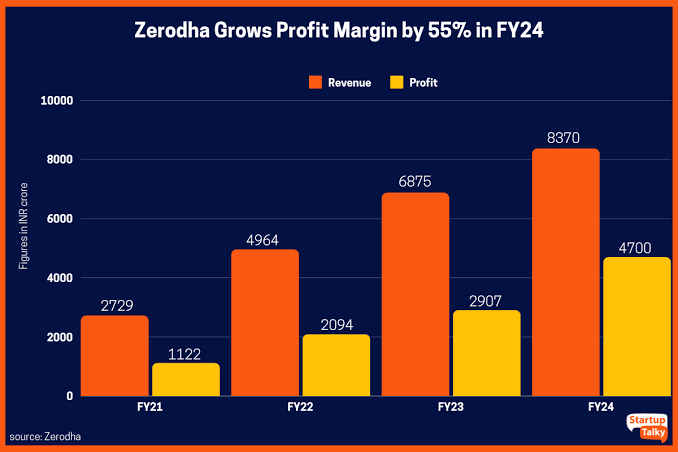
The results were remarkable. In FY25, revenue fell 11.5% to ₹8,847 crore and net profit dropped 22.9% to ₹4,237 crore. Even after that fall, it’s one of India’s most profitable companies with a tiny team compared to its size. In FY26, profit rose roughly 1.2% to ₹4,283 crore while revenue stayed flat. startupstoriesyourstory
Cracks in the Zerodha Business Model in 2026
It’s not all smooth. SEBI’s F&O curbs hurt volumes, and Groww has grown faster among new investors.
In July 2026, Zerodha had 6.76 million active clients and a 14.88% NSE share, while Groww had 13.12 million. The same report notes Zerodha still depends heavily on active F&O traders. That’s a risk. When regulators tighten derivatives trading, Zerodha feels it first. inc42
Kamath has said the company is now watching client assets under management more than active-client counts, which tells you where its thinking is heading.
What Founders Can Learn
Three lessons stand out. Pick one unfair advantage and bet on it. Stay lean enough that competitors can’t match your price. And don’t depend on a single revenue source forever. That last one is Zerodha’s homework for 2026.
FAQs
How does Zerodha make money if delivery trades are free?
Mostly from flat fees on intraday and F&O trades, plus smaller income from account charges and interest on funds.
Is Zerodha profitable?
Very. FY26 profit was about ₹4,283 crore, though revenue has stopped growing.
Did Zerodha take venture funding?
No. It’s bootstrapped, and the founders have said so often.
Who owns Zerodha?
Founders Nithin and Nikhil Kamath, along with a few other shareholders.
Is Zerodha still India’s largest broker?
By revenue and profit, yes. By active clients, Groww has overtaken it.
Why did Zerodha’s profit fall in FY25?
Regulatory changes in F&O, lower trading activity and higher costs all played a part.
Conclusion
The Zerodha business model won because it did the opposite of old brokers: flat pricing, no sales force, heavy technology and trust earned through honesty. It’s still hugely profitable, but growth has stalled and F&O dependence is a real worry.
If you’re building a business, study how Zerodha stayed lean and let customers do the marketing. And if you’re an investor, don’t judge a broker by free-trade headlines alone. Check how it makes money before you open the account.
Internal linking suggestions:
- [link to guide on discount broker vs full-service broker here], in the traditional brokers section
- [link to article on F&O trading rules and SEBI changes here], in the cracks section
- [link to bootstrapping a startup in India guide here], in the founders’ lessons section
Image alt text suggestions:
- “Zerodha Kite trading app on a phone showing a flat ₹20 brokerage order”
- “Chart comparing Zerodha business model brokerage fees with traditional broker charges”
- “Zerodha and Groww active clients comparison in 2026”