
It’s 9:15 a.m. You have 47 unread emails, a client call at 11, a team member waiting outside your cabin, and a quarterly plan you’ve been “about to start” for three weeks. By evening, you’ve been busy all day and finished nothing that matters.
Sound familiar? Most managers don’t have a time problem. They have a sorting problem. The Eisenhower matrix is a simple way to fix that, and it takes about ten minutes to learn. Here’s how it works, with examples from a manager’s real day.
[Image alt text: Manager sorting tasks into four boxes using the Eisenhower matrix on a notepad]
What Is the Eisenhower Matrix?
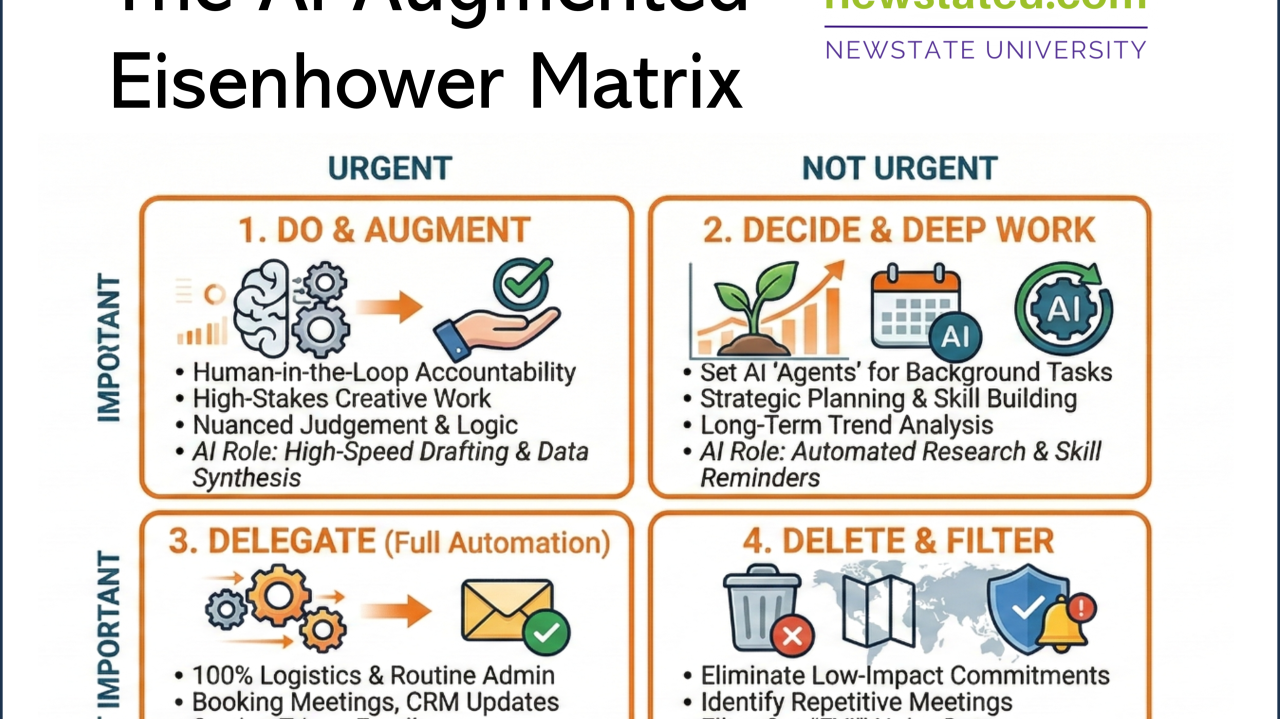
The Eisenhower matrix is a decision tool that sorts tasks into four boxes based on two questions: is it urgent, and is it important? The boxes tell you to do it now, schedule it, delegate it or drop it. It’s named after US President Dwight D. Eisenhower.
Eisenhower reportedly said that what’s important is seldom urgent, and what’s urgent is seldom important. That’s the whole idea in one line. Stephen Covey later popularised the four-box layout in The 7 Habits of Highly Effective People.
The trick is that urgent and important are different things. A ringing phone is urgent. Your team’s growth plan is important. Managers keep confusing the two.
The Four Quadrants Explained
Think of a grid with urgent on one axis and important on the other.
- Quadrant 1: Urgent and important. Do these now. A client escalation, a production outage, a deadline due today.
- Quadrant 2: Important, not urgent. Schedule these. Strategy, coaching, hiring plans, process fixes.
- Quadrant 3: Urgent, not important. Delegate these. Routine approvals, many meetings, most calls and pings.
- Quadrant 4: Neither. Eliminate these. Mindless scrolling, pointless reports, meetings with no purpose.
Most managers I’ve met live in Quadrants 1 and 3. They know Quadrant 2 matters, but it never gets a slot in the calendar.
Eisenhower Matrix Examples for a Manager’s Day
A manager can use the Eisenhower matrix by listing every task for the day, marking each as urgent or important, and then placing it in one of four boxes. Do Box 1 first, block calendar time for Box 2, hand off Box 3, and delete Box 4.
Picture a sales manager at a Jaipur electronics distributor. Here’s how her Monday sorts out:
- Do now (Q1): A key retailer’s shipment is stuck, and payment is blocked. She calls the logistics head herself.
- Schedule (Q2): Quarterly training for her two new reps. She blocks Wednesday, 3 to 4 p.m.
- Delegate (Q3): Updating the weekly stock sheet and booking a vendor meeting room. Her executive handles both.
- Eliminate (Q4): A long daily sales report that nobody reads. She stops it and watches whether anyone complains.
Nobody complained. That’s a common result, and it’s the most satisfying one.
How to Delegate Quadrant 3 Without Dropping the Ball
Delegation is where managers slip. They hand off a task but leave out the context, then redo it themselves.
A good handoff has four parts:
- The result you want, not just the task
- The deadline
- The limits of their authority (can they spend money? contact clients?)
- A check-in point
It feels slower the first time. By the third time, you’ve saved hours every week.
And be honest about whether a Q3 task really is low value. A “quick approval” that blocks your team for two days is more important than it looks.
Protect Your Quadrant 2 Time
Quadrant 2 tasks are important but not urgent, so they get postponed until they become Quadrant 1 emergencies. Protect them by putting them in your calendar as fixed appointments, ideally during your most focused hours, and treating them like client meetings.
This is the real payoff of the Eisenhower matrix. Time spent in Quadrant 2 means fewer fires later. Coaching a junior now prevents rework next month. Fixing a broken process now stops the same complaint from returning every week.
I block the first hour of my day for Q2 work, with notifications off. It isn’t glamorous, but it’s the hour that usually makes the week better.
Mistakes Managers Make With the Eisenhower Matrix
- Calling everything urgent. If all tasks are Q1, you’ve only built a longer to-do list. Ask who is actually harmed if it waits until tomorrow.
- Never visiting Quadrant 2. If your calendar has no strategic time, you’re firefighting.
- Overusing Quadrant 3. Many “urgent” pings come from other people’s priorities, not yours.
- Being too strict. The grid is a guide. Don’t spend 40 minutes sorting 10 tasks.
One more thing. The matrix works at the team level too. A quick weekly sort with your team shows who is stuck in Q3 work that someone else could do.
A Simple Daily Routine
You don’t need an app. A notebook works.
- Each morning, list everything on your plate for five minutes.
- Mark each task Q1, Q2, Q3 or Q4.
- Pick one Q2 task and book time for it.
- Delegate or delete the rest.
- Review at the end of the day and adjust.
Digital tools like Google Calendar, Notion or Microsoft To Do can mirror this, but start on paper if you can.
FAQs
What is the Eisenhower matrix in simple words?
A four-box grid that helps you sort tasks by urgency and importance, so you know what to do now, schedule, delegate or drop.
Who created the Eisenhower matrix?
It’s named after Dwight D. Eisenhower, who was known for his decision-making. Stephen Covey later popularised the four-box version.
How do I use the Eisenhower matrix every day?
List tasks each morning, sort them into the four boxes, do Q1 first, book time for Q2, and delegate or delete the rest.
What is the difference between urgent and important?
Urgent tasks demand attention now, usually because of a deadline or another person. Important tasks support your long-term goals, even if nobody is chasing them.
Is the Eisenhower matrix good for teams?
Yes. Teams can use it in weekly planning to spot misplaced priorities and share work better.
What are the limits of the Eisenhower matrix?
It doesn’t estimate effort or handle dependencies between tasks. For complex projects, combine it with a proper project plan.
Conclusion
The Eisenhower matrix is a simple habit with a big payoff: sort tasks honestly, do the urgent and important first, protect time for important-but-not-urgent work, and delegate or delete the rest. It won’t create extra hours, but it makes sure the hours you have go to the right things.
Tomorrow morning, spend five minutes sorting your task list into four boxes. Pick one Quadrant 2 task and put it in your calendar before you open your email. Do that for a week and see how many fires you stop fighting.
[Link to related guide: how to delegate effectively as a new manager]
Internal link suggestions:
[link to guide on first time team leader tips here]
[link to article on how to say no at work politely here]
[link to post on daily planning methods for managers here]
Image alt text:
“Manager sorting tasks into four boxes using the Eisenhower matrix on a notepad”
“Eisenhower matrix grid showing do, schedule, delegate and eliminate quadrants”
“Manager blocking focus time in a calendar for important but non-urgent work”


